FutureSim!
Making Europe’s Future Sustainable!
2022-2024
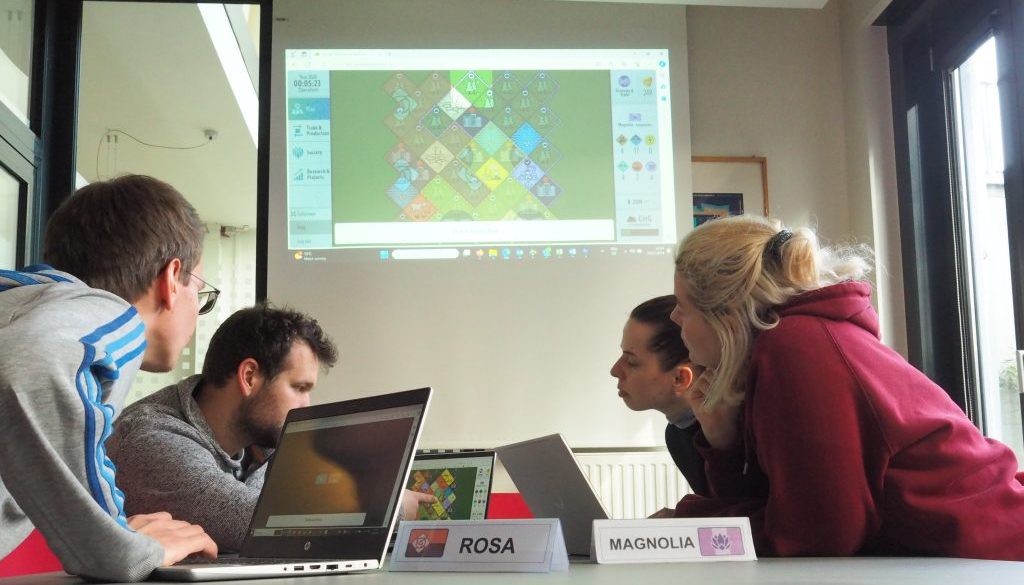
In the project Making Europe’s Future Sustainable! (FutureSim!) a simulation-based learning program (Up2You!) for schools, a comprehensive game-based learning and teaching program on sustainable development for cross-curricular education in secondary schools was developed.
The learning program fosters citizens’ competencies among Europe`s youth, making them more aware of global challenges and encouraging them to become active changemakers. The learning program provides solutions that meet school education`s requests of high quality and innovative open access digital learning resources. In order to ensure that approach, all resources will be developed in cooperation with teachers and school students involving a diverse range of participants.
https://uptoyou.socialsimulations.org/
Eucu.net took part in this Erasmus+ Programme as one of the dissemination partners.
ENPRENDIA
Enhancing Female entrePREneurship in iNDIA)
2019-2022
The general objective of ENPRENDIA was to enhance entrepreneurial culture among female population in Indian Higher Education Institutions while promoting gender equality and gender equity – not only inside the walls of academic institutions but also extending it to civil society and their local communities.
Indian society is characterized by miscellany in caste, religion, languages, festivals, attire, economic status and location, among others. However, for various reasons the representation of various groups of the society in terms of participation within the higher education system has remained historically unequal. The emphasis laid on providing an equitable access to opportunities to female students representing various diversified groups was highlighted in ENPRENDIA.
The project intended to achieve this by developing a creative and supportive environment at institutional and local community level through the establishment of Entrepreneurial Research Centers (ERCs). These ERCs should have formed together a network, which would serve as platforms to encourage and foster female participation in society, create and share entrepreneurial ideas and at the same time support the bridge that links local communities, enterprises and universities through participation of female population in the socio-economic development of the country. A special mention was devoted to the organisation of activities by ERCs to foster enterpreneurial mindsets among children and young people.
Eucu.net took part in this Erasmus+ Programme as one of the dissemination partners.

European Researcher’s Night
Science Communication Programmes powered by the Marie Skłodowska-Curie Actions
The idea of the European Researchers’ Night within the framework of Horizon2020 is to run parallel, Europe-wide public events to raise the awareness on science careers and the enhance the public recognition of researchers in general. As special attention of the European Researchers’ Nights focuses on the involvement of young people and children, also organizers of Children’s Universities have been involved in varoius programmes around Europe. The European Children’s Universities Network as an umbrella organisation of Children’s Universities currently participates in two national European Researchers Night programmes. One event is organized by the University of Mersin in Turkey and the other one is run by the Practical Robotics Institute Austria (PRIA) in Vienna in Austria. Both European Researchers’ Night proposals have been approved for the years 2018 and 2019.
More information about the European Researcher’s Night Action is available at the website of the European Commission:

European Researchers Night in Mersin – International Mersin Science Night
2018-2019
The European Researchers Night in Mersin covered all layers of society from all ages and aims to convey scientific content, topics, concepts and processes via interactive applications. The event was organized in a mix of open-air and closed venues and strives to form an awareness regarding diverse scientific topics as nature, science and technology but also cultural heritage and humanities. Main objective was to instruct society scientific knowledge in an entertaining and understandable manner. (text by University of Mersin)
European Researchers Night in Vienna – Sci4all
2018-2019
The key objective of the Sci4all project was to involve the citizen science movement in a frame of several pre-event activities such as trainings, challenges and conferences as well as in a broad spectrum of innovative event activities at the actual European Researchers’ Night. This incorporated formats such as Science Slams and Science Cafes, more than 34 scientific booths and 16 workshops as well as social activities to bring the public and science closer together, but also to encourage young people to pursue a career in the STEM domains. (text by sci4all)
InEDU – Innovate, Educate, Awake
2016-2018
The InEdu Project aimed to promote active learning based on observation, experiment and conclusion making which are part of the scientific method. Within the project new teaching materials and tools have been developed to help primary school teachers prepare and conduct more fascinating lessons which can stimulate the children’s natural curiosity.
As part of a training scheme teachers have been invited to exchange their educational methods and tools so that they had the chance to develop their skills and create interesting and effective methodology on the basis of the experience gained during the project.
One of the outcomes was the design of an exploration box: “Spikey’s Journey” about environmental issues for primary school kids.
Eucu.net participated in this Erasmus+ project (#2016-1-PL01-KA201-026744, 2016-2018) as a dissemination partner.
SciChallenge
2015-2017
The SciChallenge project (#665868, H2020-SEAC-2014-1) developed novel concepts to inspire young people to work with science, scientific methods and insights. The idea was to use a contest-based approach to encourage self-produced digital education materials by young people for young people. The project was driven by inspiring topic sheets, guides and toolkits that have been created in this project and distributed to partner schools, teachers and other youth-oriented institutions as well as through various social media channels.
Furthermore, the material was aggregated on the SciChallenge Web Platform to generate wide reaching awareness and promotion. Individual or collective competitors between the ages of 10 to 20, who have participated in the SciChallenge, generated creative digital materials (videos, slides, or infographics).
The SciChallenge Platform also increased awareness of science careers and opportunities for internships or open days in STEM institutions through the strong involvement of related organisations and industries. Additionally, aggregated information on science events (slams, nights, festivals etc.) was shared. With this multi-level approach, SciChallenge boosted the attractiveness of science education and careers among young people leading to wider public engagement with science and economic prosperity and global competitiveness on a pan-European level.
Eucu.net participated as a dissemination partner and provided also experts to the international jury for the contest. Many contributions of young people came from the network members science engagement ecosystems.
SiS Catalyst – Children as Change Agents
2011-2014
SiS Catalyst was one of the first Mobilisation and Mutual Learning (MML) action plans funded by the European Commission under FP7 (grant agreement 266634) – and was based upon the very simple idea that present decisions in science and education are significant for tomorrow’s citizens, students and researchers – who are children and young people at this time. Currently very well demonstrated within the Fridays for Future movement.
We believe that in a fast changing technology-based world, the potential of all young people is in demand – irrespective of their social, cultural or economic background. We further believe that Higher Education and science institutions have a leading role to play in the global changes occurring – as hubs of creativity and vehicles for social justice.
SiS Catalyst considered the role which children and young people have in the development of Science in Society – and how science organisations can better engage with young people, both on a practical and a strategic level. In consequence, learning programmes and institutional development shall resonate with a young audience.
The project succeeded in creating a couple of useful tools and guidelines when it comes to working together and for children in the field of science engagement. You can find this material in our resources area as documents to download.