by Thomas Troy [Vienna University Children’s Office]
What does remembrance have to do with democracy? How are our identities shaped by the places we live in? And whose stories do we choose to remember?
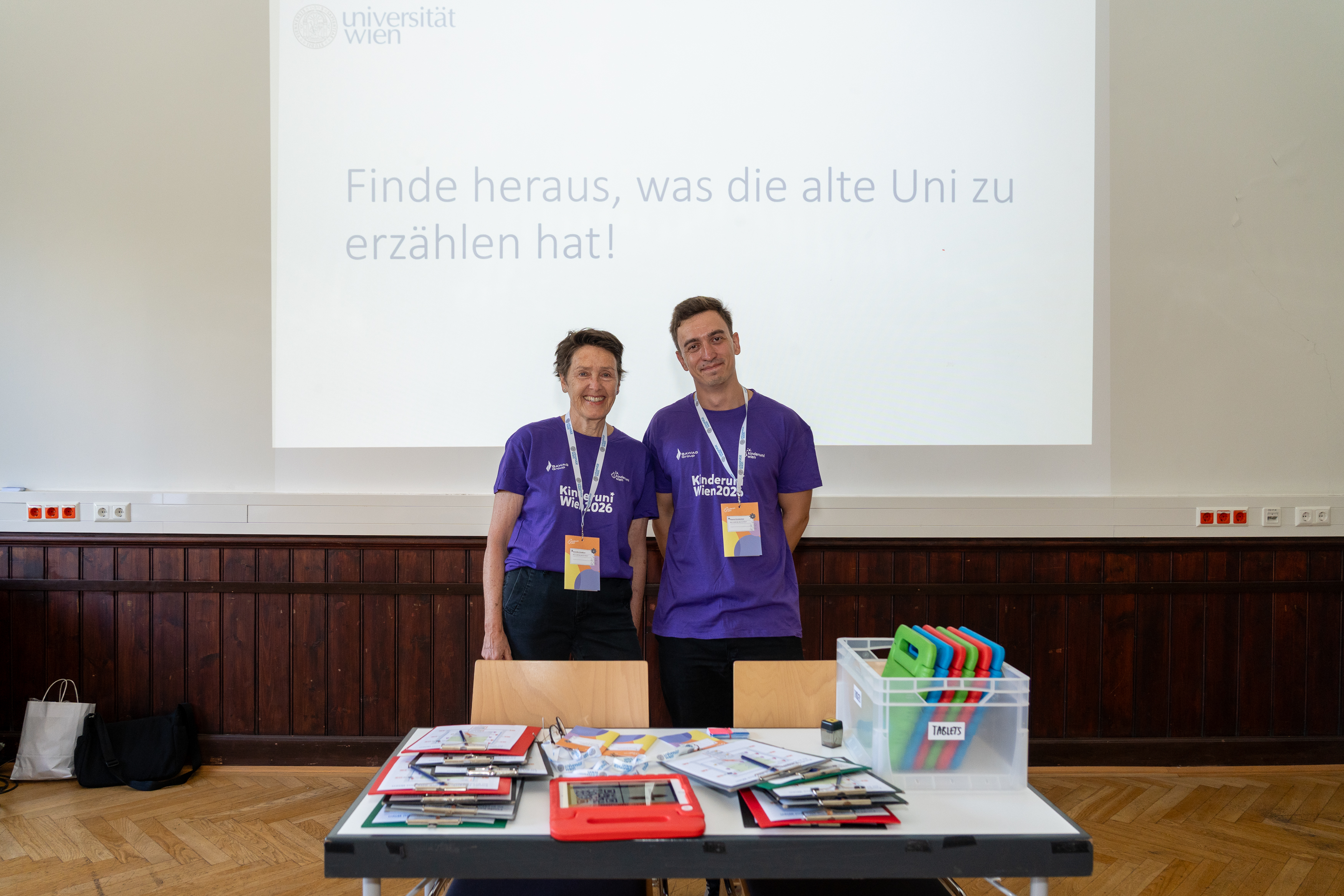
These were just some of the questions explored by children, families and researchers during this year’s Vienna Children’s University. As part of the CU REMEMBER project, remembrance education was a special focus of the programme, bringing together history, democracy, identity and personal experiences in a wide range of lectures, workshops and activities.
Every summer, the Vienna Children’s University invites children aged 7-12 to explore science and research in an engaging and hands-on way. In 2026, more than 4,000 children and around 600 researchers from seven major universities took part. Within CU REMEMBER, 10 researchers from the fields of law, philosophy, education and history developed activities that connected their research with questions of remembrance and encouraged children to look at the past and present from different perspectives.
Remembrance starts with questions
The programme showed just how many different entry points there are to remembrance. Some activities started with fundamental questions about democracy and society: What does the constitution mean for us? What does it mean to live together in society? How are decisions made in the European Union? And what does democracy have to do with our own lives?
Other activities invited children to explore questions of identity and belonging: How is our identity shaped? What does it mean to live in another country? And why are people sometimes forced to leave their country?
Remembrance was also explored through the history of the University of Vienna itself. Children learned about researchers who were persecuted and displaced for political or religious reasons and explored places at the university connected to its history and remembrance culture.

From lectures to shared memories
But remembrance at the Children’s University was not limited to lectures and seminars. The CU REMEMBER team created a Memory Wall as a space for children, parents, grandparents and researchers to share their own memories.
Organised around four simple categories – Objects, Time, Places and People – the Memory Wall invited participants to reflect on what they remember, what memories are passed on within families and how personal experiences connect to larger historical events.They memories included stories passed down by grandparents, references to the University of Vienna, memories of the war in the Balkans and first experiences as refugees in Austria, as well as memories connected to holidays and travel. Together, these memoreies showed that remembrance is not something that belongs only in history books or museums. It is also personal, emotional and deeply connected to our everyday lives. You find more information about the Memory Wall in the blog post “Collecting Memories Across Generations: The CU REMEMBER Memory Wall”
Keeping the conversation going
The conversations and memiers collected during the Children’s University will also continue beyond the event. Selected insights will be explored in upcoming CU REMEMBER blog posts and shared with participants at the project’s final event in February 2027.
All images by © Markus Korenjak and Alexander Bachmayer
|
Funded by the European Union. Views and opinions expressed are however those of the author(s) only and do not necessarily reflect those of the European Union or the European Education and Culture Executive Agency (EACEA). Neither the European Union nor EACEA can be held responsible for them. |